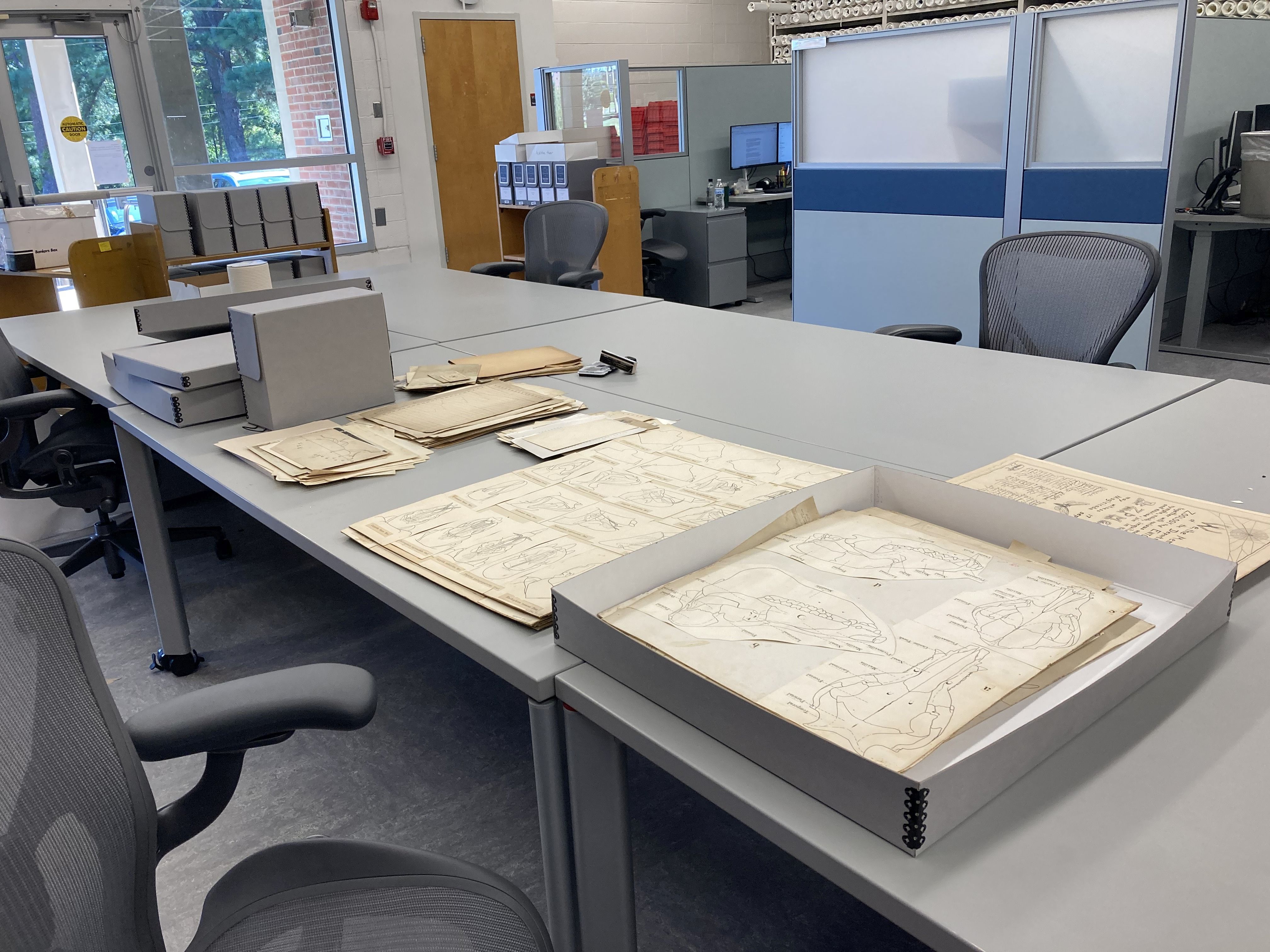
Space for Archival Processing at the Special Collections Research Center
Space for Archival Processing at the Special Collections Research Center
This blog post was written by Ella Mayfield. Ella is a graduate extension assistant in the Special Collections Research Center enrolled in the Public History masters program.
When a new employee is hired at the Special Collections Research Center, they must learn the ins and outs of archival processing, which involves rehousing, labeling, categorizing, and describing materials. Processors take the materials that SCRC acquires and place them in archival storage boxes and folders for preservation. Each collection has its own unique characteristics, and the longer a processor works with SCRC, the more types of materials they will encounter. Each format encountered requires a different approach to physical housing and data entry. New and existing processors use the SCRC’s Processing Manual to learn how to survey, accession, house, and describe archival materials. For many years, the SCRC used a processing manual that became outdated and difficult to navigate due to updates, rewrites, and new procedures. Because of this, SCRC staff worked over the past few months to reorganize and rewrite it.
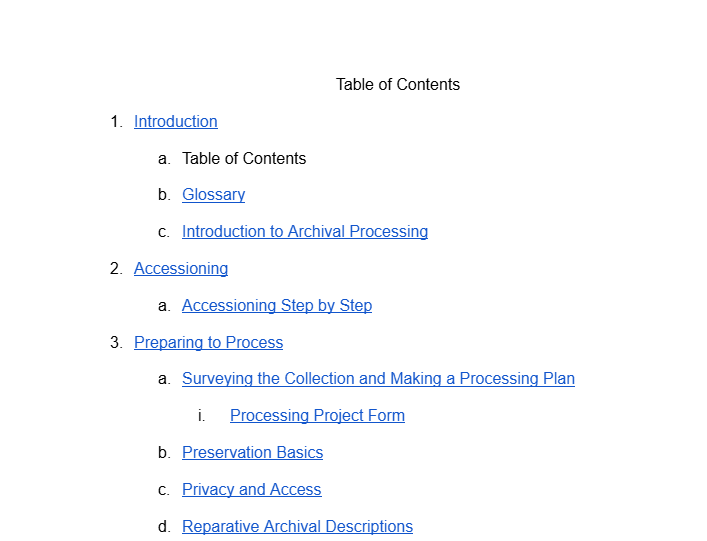
The new manual uses straightforward titles and does not unnecessarily divide subjects. Rather than having processing split into “Preparing to Process,” “Arranging,” “Describing,” and “Housing,” all of these facets are in one document and in the order that processors will perform them. Because the original processing manual was used for many years and had multiple staff members contributing to it, there were redundant files and instructions. The new manual condenses and clarifies these sections. To make things even easier to navigate, we added a table of contents where all files are linked to their corresponding title.
Aside from organization, the new processing manual references archival theory that served as the foundation of the original manual while providing processors with more step-by-step instructions and practical guidance. As archivists, theory is essential because it guides ethical decision making and allows employees to understand the “why” behind their actions. The new processing manual condenses the essential information in the Archivists’ Code of Ethics and provides a detailed list of examples of items that might need restricting or deaccessioning. It also gives step by step instructions on how to restrict, deaccession, or redact confidential information.
The new manual also addresses archival theory by providing links for processors such as Special Collections’ Ethics in the Archives blog series and DACS (Describing Archives: A Content Standard). Each step in the “Processing Step by Step" document provides a link to its corresponding section of DACS, where processors can find more information about why SCRC processes in a certain way. This document also contains a link to “More Product, Less Process,” a study that guides the SCRC’s levels of processing and turn around time.
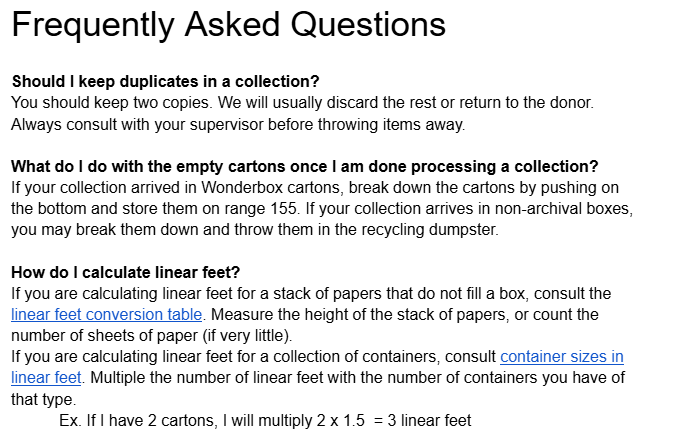
The final step to making the new manual more user friendly was adding visual and supplemental resources. One of the main issues with the original manual was that processors did not know where to find the answers to their questions. The new manual addresses this problem through reorganization and more accurate titles, but when processors still cannot find the topic they are looking for they can reference the “Frequently Asked Questions.” This document covers miscellaneous topics that users may not know where to look for, along with common issues new processors face. The new manual also recognizes that archives have their own language, so it includes a glossary with common archival terms and a list of containers and supplies with images of them. This way, employees can get to know the vocabulary used in archival processing and the names of supplies they will handle.

In addition to providing straightforward instructions for processors, the new manual includes some new sections. The archival world steadily evolves as practitioners develop new ways of thinking about knowledge production and strive to create an inclusive, comfortable environment for researchers. For example, archivists in the past sometimes used language that we now consider outdated and/or offensive, and some of the materials we collect use racist, ableist, or otherwise discriminatory language. The SCRC strives to contextualize this language by adding reparative archival descriptions (RAD) to collections explaining that certain words are harmful but are often kept in folder and collection titles to accurately reflect the time period.

The SCRC also collects a lot of materials from animal rights and welfare organizations, and they often contain graphic images of animal abuse. This can be distressing for viewers, so processors mark folders and boxes that contain graphic materials and add a note to the finding aid so that researchers can either be prepared to view these objects or avoid them. The manual also addresses the trauma these images can inflict on the processor looking at them. The processing manual includes instructions on writing RAD and graphic content notes. Institutions like the SCRC influence how people approach their research and contain a variety of materials that researchers should be prepared to view. Therefore, the processing manual and the methods used by the SCRC are updated regularly to follow modern standards. Archival processing manuals should be iterative and reviewed at regular time periods as archival practice evolves. For example, the SCRC continues to work on collapsing born digital processing and web archiving documentation into the manual, uniting both physical and digital processing in the same place.

With these changes, new SCRC employees can more easily adapt to the archival world and develop a practical understanding of archival processing. With so many new terms and practices to learn, it is essential that employees have a comprehensive, straightforward manual to guide them.
If you have any questions or are interested in viewing Special Collections materials, please contact us at library_specialcollections@ncsu.edu or submit a request online. The Special Collections Research Center is open by appointment only. Appointments are available Monday–Friday, 9am–6pm and Saturday, 1pm–5pm. Requests for a Saturday appointment must be received no later than Tuesday of the same week.
Opens in your default email client
URL copied to clipboard.